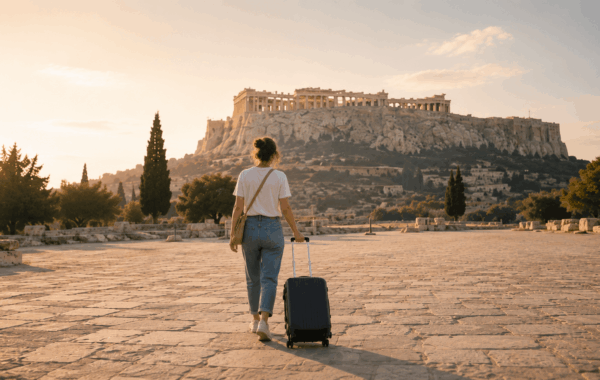

There is an irony in the word *nomad*: it has been adopted by English, French, and nearly all European languages — and now it returns to Greek almost as a loanword, as if we had forgotten that it was always ours. *Nomás*: the one who moves, who does not settle, whose place is not a fixed point but a trajectory. The word traveled, became global, and came back. And that, in itself, says something.
Humanity did not begin seated. For most of its existence — hundreds of thousands of years — the human species followed the seasons, the animals, the water. Settlement, the city, the permanent address are, in evolutionary terms, a very recent experiment. If we were to compress our entire history into a single day, we have been sitting still for only the last two minutes. The body still remembers.
The tension between Hestia and Hermes. Within this necessity for survival, somethingmore restless was born: the desire to see what lies beyond. Perhaps because the human being has always balanced between two powerful forces: Hestia, who calls for warmth, stability, and the center, and Hermes, who whispers of unknown boundaries,exchange, and the road. This inner tension gave rise to the Polynesian who crossed
the Pacific in a canoe without a map, reading the waves. It gave rise to the ancient Greek merchant who departed from Piraeus toward unknown shores — not only fortrade, but because beyond the visible horizon there was something pulling him forward. What the Latins would later call *curiositas* — a dangerous, untamedcuriosity.
Travel, then, was never merely a displacement in space. Carl Gustav Jung, who traveled from Africa to New Mexico not as a tourist but as an analyst of his own psyche, saw in the nomadic impulse something deeper than a social habit: an archetype. The soul, he suggested, is drawn to what it does not yet know about itself. The external journey and the inner exploration are not parallel paths — they are the same path. Every movement through space reflects a movement within us. One does not leave in order to find something foreign; one leaves in order to encounter something already carried within, not yet seen.
This explains Kerouac, Chatwin, and every person who, at some point in their life,
looked at a map and felt something pulling — without being able to fully explain what.
Today, nomadism has taken on new forms, but the same impulse remains. The leisure traveler who avoids packages and all-inclusive experiences is not merely seeking the sun — they are seeking friction with the unfamiliar, a moment in which a new place makes them feel small in the right way. The digital nomad, working from different cities, has — for the first time in history — detached work from place.
Yet this freedom of being “in-between” often comes with a cost: a peculiar loneliness, the feeling of being everywhere a stranger and everywhere at home. And the one who changes base reopens the oldest question: what is home? A place you return to — or a place you create wherever you are?
Perhaps nomadism is never fully modern, nor ever fully ancient. It is simply what a human being does when they listen to themselves: they rise, and they go. Not to escape from somewhere, but to return to themselves.